The Treasure
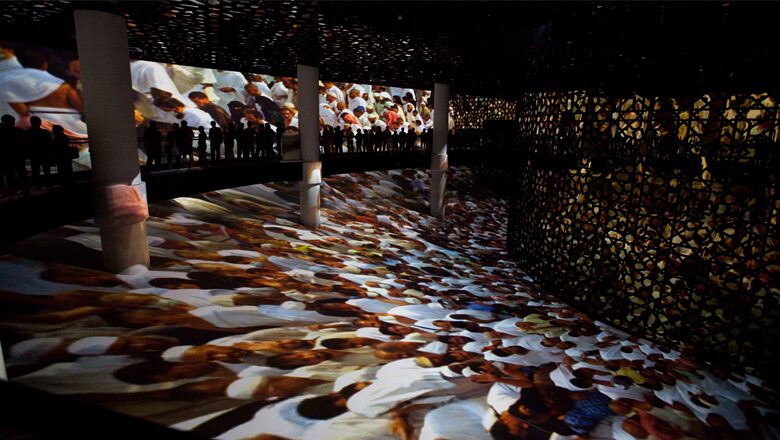
The Treasure transformed a 1,600 m² concave floor projection and mirrored ceiling into a “flying carpet” of images and sound. A slow-moving conveyor belt carried visitors along a curved bridge above the projection, while floral patterns, landscapes and city scenes of Saudi Arabia washed across the entire space in continuous motion.
Twenty-five HD projectors and a 70-piece orchestral soundtrack created an enveloping media environment that positioned Saudi Arabia as both rooted in heritage and oriented toward innovation.

A flying carpet of light
TMS conceived the main show as a single, continuous spatial gesture: a “flying carpet” of moving images under a mirrored sky.
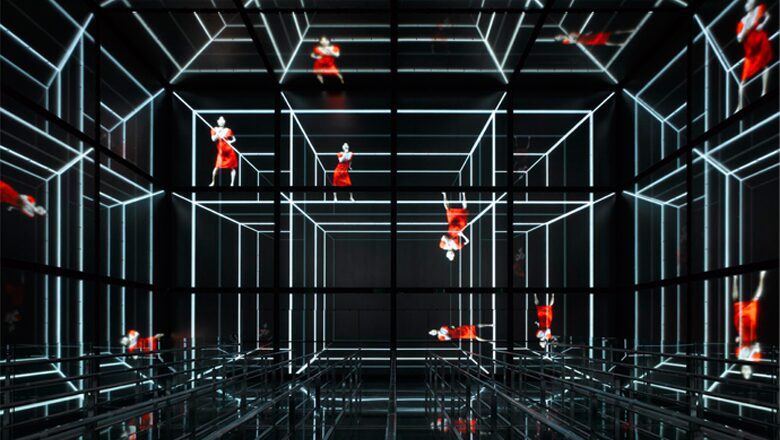
Visitors entered the belly of the ship and stepped onto a conveyor belt that followed the curve of the room, lifting them onto a bridge over a vast concave projection surface covering the entire 1,600 m² floor. Above, an oriental mirror mosaic on the ceiling multiplied the visuals into apparent infinity, dissolving clear boundaries of floor and wall.
Twenty-five seamlessly blended HD projectors cast high-resolution imagery across the floor and lower walls, including sequences derived from IMAX material. Floral forms, calligraphic ornaments, urban vistas and desert landscapes flowed in choreographed cycles from the deepest point of the room outward, so that visitors never saw a static frame but a continuous transformation.
A bespoke orchestral score recorded with a 70-piece ensemble was mixed for the full volume of the space, aligning musical phrases with visual transitions to create a tightly integrated, cinematic environment.

Riding through an endless room
The visit unfolded as a slow, collective ride: standing on the moving floor, visitors glided above the “carpet”, surrounded by reflections from the mirrored ceiling and the glow of the images on the walls. The room felt both architectural and immaterial, as if suspended inside an endless sea of patterns and scenes.
Instead of a conventional narrative voice-over, the show relied on visual and musical dramaturgy. Shifts in color, tempo and motif guided perception from textures to wide aerial views, from heritage motifs to signals of technological progress. The main show functioned as a wordless, emotional introduction to Saudi Arabia for a highly diverse international audience, turning their short time in the pavilion into a memorable, physically felt sequence.


Making an iconic pavilion experience
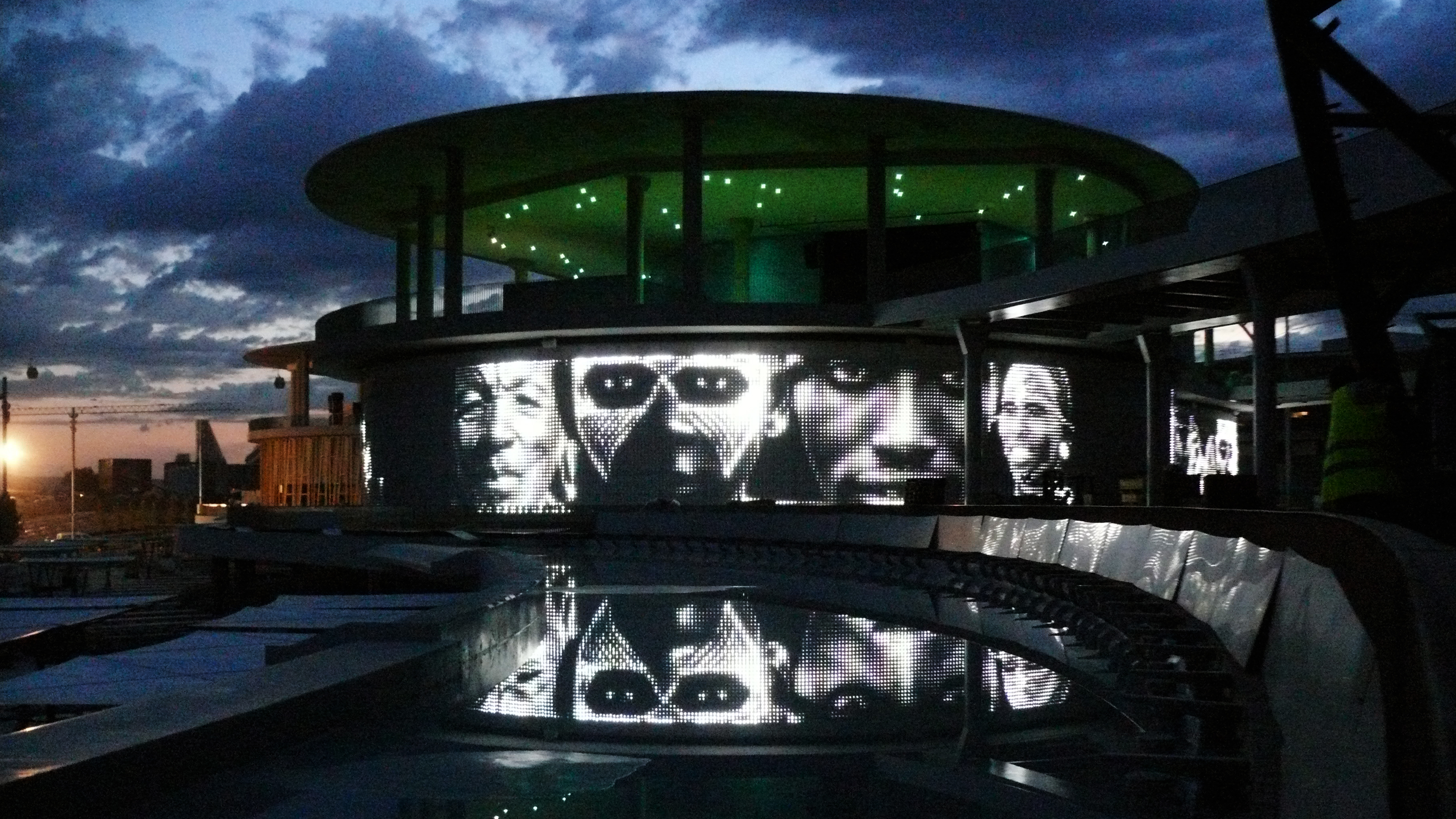
Saudi Arabia wanted to move beyond a static national showcase and present a confident, contemporary image at the world’s largest EXPO to date. The pavilion architecture already made a strong statement: a ship’s hull resting on columns, its roof forming an oasis of palm trees above the exhibition spaces.
The challenge for the main show was to translate this ambition into an experience that felt both iconic and accessible. The space needed to speak to millions of international visitors each with only a few minutes inside, conveying beauty, pride and a sense of forward momentum without conventional exhibition displays or linear film screening.


The Saudi Arabia Pavilion counted among the most visited national pavilions on site, attracting up to 25,000 visitors per day and ultimately several million guests over the course of the exposition and afterwards was re-opened due to high demand from the public until 2021.
The Treasure acted as the pavilion’s emotional core, widely reported in media and professional circles as one of the standout large-format immersive experiences of the EXPOs.
Its combination of architectural scale, media integration and orchestral sound was one of the first examples of complex, high-end experiential environments.
Project Highlights

- 1,600 m² concave projection floor forming a “flying carpet” of moving imagery
- Twenty-five HD projectors blended into one seamless image field
- Mirrored mosaic ceiling multiplying images into an apparently endless volume
- Conveyor-belt bridge guiding visitors through the show without breaking immersion
- Original orchestral soundtrack recorded with 70 musicians for the specific room acoustics
- One of the most visited national pavilions at Expo 2010, with up to 25,000 visitors per day
Facts & Figures
Lead agency: Acciona Producciones y Diseño S.A.
Scenography: Boris Micka
Hardware planning and technical implementation: Sky-Skan Europe GmbH
Music and sound design: Bluwi Music and Sounddesign GbR
Art direction and motion design: m box bewegtbild GmbH
Image and Video Credits: TMS & m box bewegtbild GmbH
Awards
Links