Invisible Worlds
At the American Museum of Natural History in New York, Invisible Worlds immerses visitors in the hidden networks that connect all life on Earth. This 360° cinematic environment transforms cutting-edge scientific data into an emotional exploration of life’s invisible systems, from ocean currents and forest canopies to neural pathways and DNA.
Tamschick Media + Space created the immersive media experience and spatial narrative for the purpose-built venue in the Richard Gilder Center for Science, Education, and Innovation, fusing science visualization with large-scale artistic storytelling.

Life revealed as a web of networks
Invisible Worlds stages life on Earth as a web of interdependent networks. The experience moves seamlessly across scales and places—deep oceans, rainforests, cities, and the human brain—showing how patterns repeat and connect.
Visitors enter a wide, oval space whose high walls and mirrored ceiling dissolve the boundary between observer and environment. Scientific data sets become flowing visual compositions, choreographed so that natural processes, human infrastructures, and microscopic structures reveal their shared logics and rhythms.


Stepping inside the data of Earth
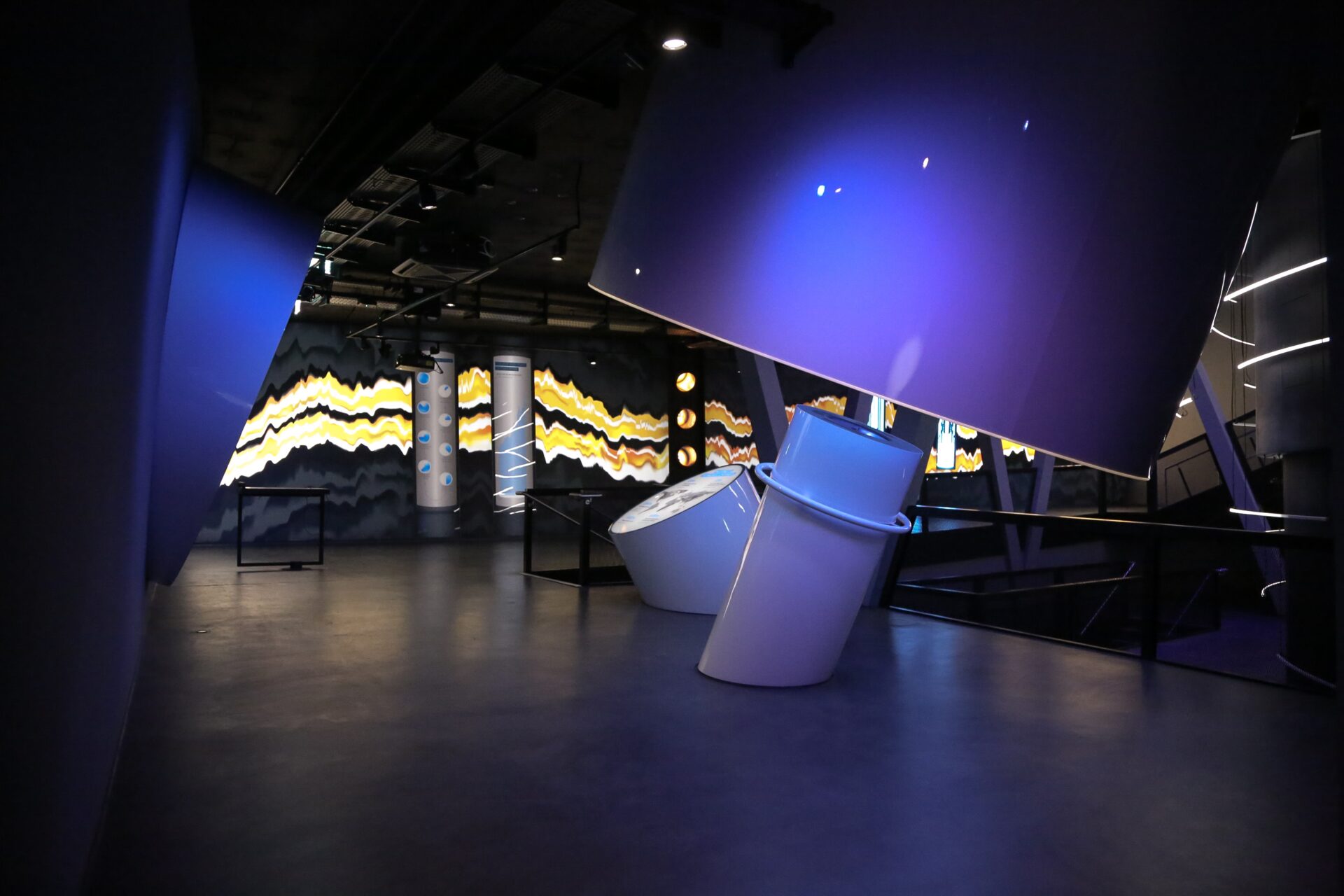
The journey begins in an introductory gallery that prepares visitors for the invisible: media installations, objects, and interactive media reveal that some connections in nature are visible while others remain hidden in scales of time and space.
In the main venue, a 12-minute looping experience surrounds visitors with 360° projections and an interactive floor, illustrating inter-dependencies within Earth’s ecosystems and the ways communication occurs at all levels, from schooling fish and forest dynamics to satellite views of cities and signals firing in the human brain.
As visitors move through the space, they experience science as a living environment rather than a static display, gaining an intuitive sense of how all life is linked through shared structures and processes.



Science beyond the visible spectrum
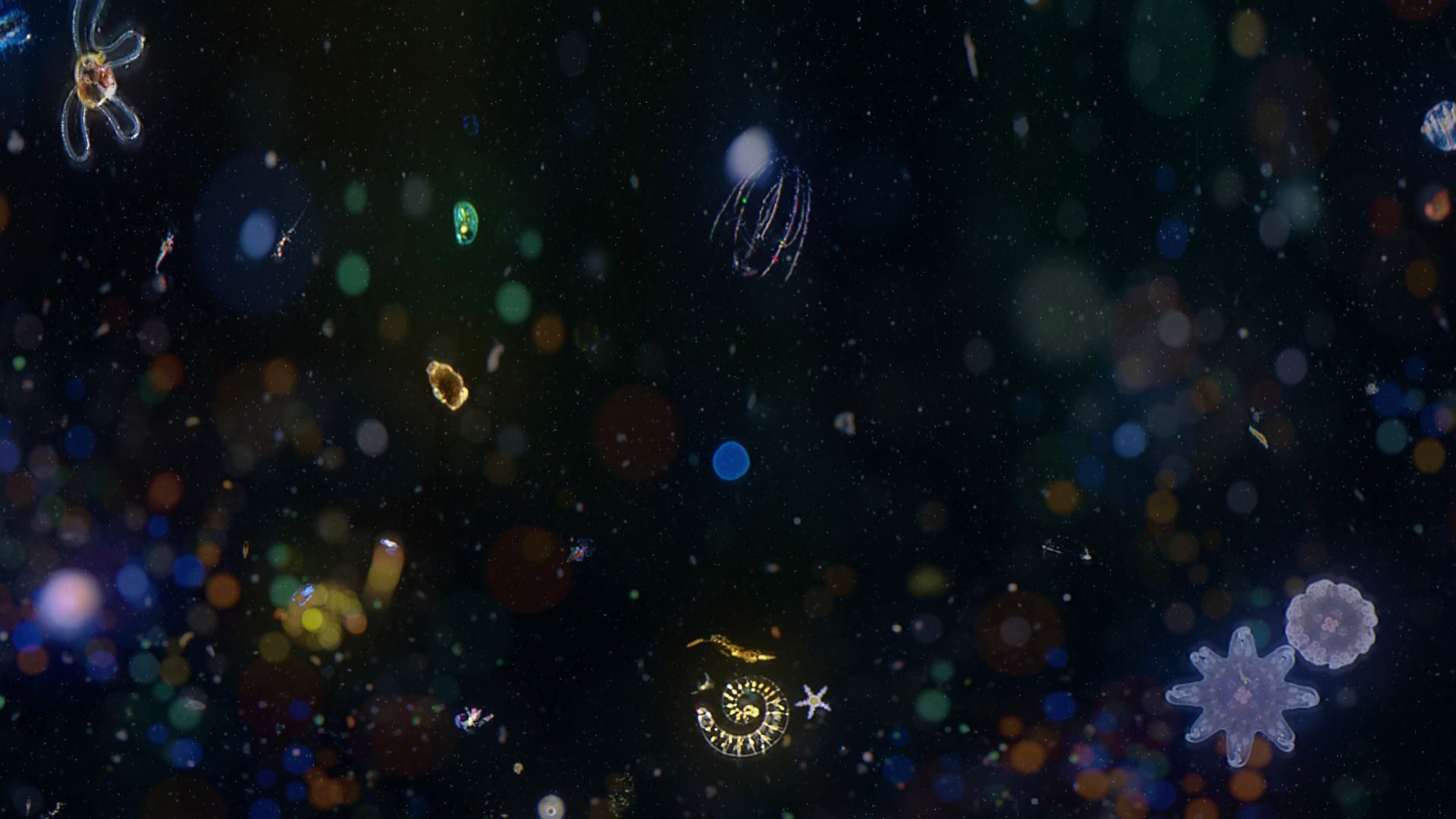
AMNH sought a new exhibition mode to communicate complex, multi-scale science to a broad public: phenomena that are too small, too vast, too fast, or too slow for the human eye to perceive.
The new Gilder Center needed a flagship experience that could extend the museum’s tradition of dioramas and planetarium shows into a fully enveloping, data-driven environment. Scientific rigor, emotional resonance, and accessibility for diverse audiences had to coexist in one coherent spatial format.


Invisible Worlds establishes a new benchmark for how museums can communicate complex, data-driven science through immersive media. It deepens AMNH’s long-standing role as a translator between research and public understanding.
The experience has attracted wide public attention and critical recognition, with extensive media coverage.
Project Highlights

- 360° immersive environment that extends AMNH’s diorama and planetarium tradition into a new presentation format
- Data-driven visualizations built from research collaborations and scientific data sets across multiple institutions and disciplines
- High-resolution projection system and mirrored architecture creating a continuous visual field that dissolves spatial boundaries
- Advanced sound design using natural recordings, sonified data, and a 360° audio system to spatialize scientific phenomena
- Interactive floor layer that responds to visitor presence and reinforces the idea of humans as active participants in Earth’s networks
- Scientific basis is built by research and data sets from AMNH scientists and external partners like New York Botanical Garden, BigBrain Project, Scripps Institution of Oceanograph
- Key locations depicted are San Diego Bay (California), Caxiuanã National Forest (Brazil), Central Park (New York City)
Facts & Figures
Scientific leadership, curation, and production: American Museum of Natural History
AMNH Team: Vivian Trakinski - Director of Science Visualization, Benjy Bernhardt - Sr. Director of Engineering & AV, Robert Williams - Senior Director of Construction, Laura Moustakerski - Writer/Producer Sc. Visualization Group, Sandya Viswanathan - Sc. Visualization Group, Loretta Skeddle - Senior Systems Administrator
Architect: Studio Gang
3D Exhibition Design and Exhibition Architecture: Boris Micka Associates & Valentin Trillo Architects
Content Development: Victoria Llanos
Sound Design & Spatial Mix: studiokamp
Interactive Programming: Colorsound ixd
A/V technical Design: Planungsbüro Seeger
Image Credits: TMS, Alvara Keding, Iwan Baan
Awards
Links
- AMNH
- The New York Times 2023.03.28
- The New York Times 2023.04.25
- Curbed 2023.04.25
- Time Out 2023.04.26
- Fast Company 2023.06.08
- TMS News: Making of Invisible Worlds