Big Bang Dark Matter
History of the Universe immerses visitors in the big questions behind CERN’s research: how the universe began, what it is made of, and how it evolves.
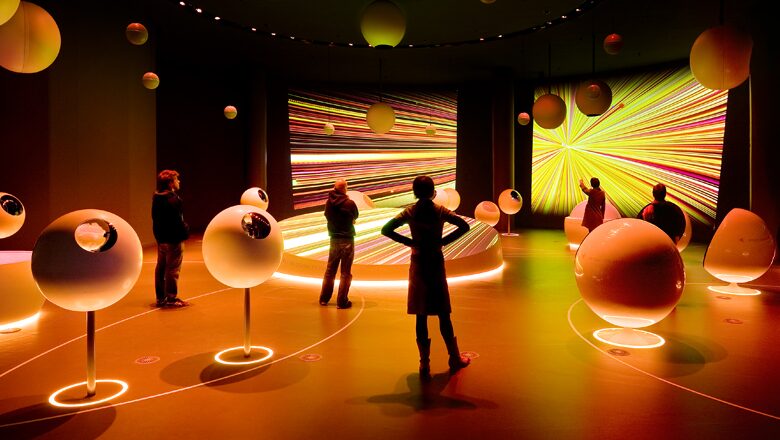
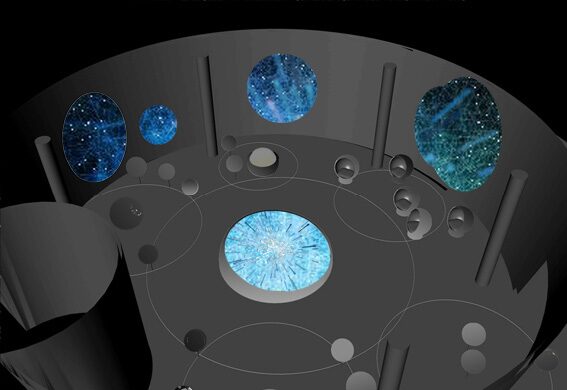
Tamschick Media + Space created the central media show: a five-part, synchronized projection that envelopes the space in animated cosmology, from the Big Bang through star formation to the birth of our solar system.
The installation translates abstract particle physics and cosmological data into a legible, emotional experience that prepares visitors to understand CERN’s Large Hadron Collider and wider scientific mission.

A Five-Screen Cosmological Narrative
TMS worked with lead agency Atelier Brückner to design a media concept in which five individual films run in perfect synchrony to form a panoramic, time-based composition around the audience.
Animated sequences visualize key stages in the history of the universe: primordial expansion, matter formation, galaxy and star birth, supernovae, and planetary systems. Visual language, pacing, and sound design are orchestrated to keep complex processes readable while preserving a sense of scale and wonder.
The resulting “media ring” surrounds visitors with a continuous image field, allowing the show to function as both introduction to CERN’s work and stand-alone cosmological story.


Standing Inside a Compressed Cosmos
Visitors enter the Globe’s main space and are enveloped by the five-fold projection and sculpted soundscape.
Over the course of the show, the room transforms from a minimal, abstract visual field into increasingly structured scenes: from near-nothingness to particle cascades, from star nurseries to solar-system imagery, closing with a return to CERN’s instruments and the human research effort.
Rather than a didactic lecture, the experience offers a guided visual intuition: guests feel the unfolding of time, density, and structure as a spatial choreography of light and sound around them.


Making Dark Matter Comprehensible
CERN needed a public-facing experience that could convey phenomena far beyond everyday perception: subatomic particles, extreme energies, and timescales from fractions of a second after the Big Bang to billions of years of cosmic evolution.
The task was to compress cutting-edge theory and experiment into a spatial narrative that non-experts could follow without diluting scientific integrity, and to anchor the visitor centre with a clear, memorable “main show” that frames the rest of the exhibition.


History of the Universe serves as the emotional and narrative anchor of the Globe of Science and Innovation, helping a broad public connect to CERN’s research agenda before engaging with more detailed exhibits.
CERN receives around 120,000 visitors per year, including students, general audiences, and science tourists; the show gives these heterogeneous groups a shared starting point for understanding particle physics and cosmology.
Project Highlights

- Synchronized five-channel projection forming a continuous panoramic media environment
- Animated visualization of cosmological evolution from the Big Bang to the solar system
- Sound design and music tailored to the Globe’s architecture for a fully spatial experience
- Core narrative that frames visitors’ understanding of CERN’s scientific work
Facts & Figures
Lead agency and general contractor: Atelier Brückner GmbH
Spatial media design and interactive installations: iart interactive ag
Hardware planning: medienprojekt p2 GmbH
Hardware implementation: ICT Innovative Communications Technologies AG
Architecture: Peter Zumthor, Thomas Büchi & Hervé Dessimoz
Image Credit: Michael Jungblut
Awards